
Evidence, Fear, and the 2026 Midterms
Oct 26, 2026 · @MattFowler
My argument fits in one sentence: on November 3, vote for candidates who trust evidence over fear.
Riboflavin is vitamin B2
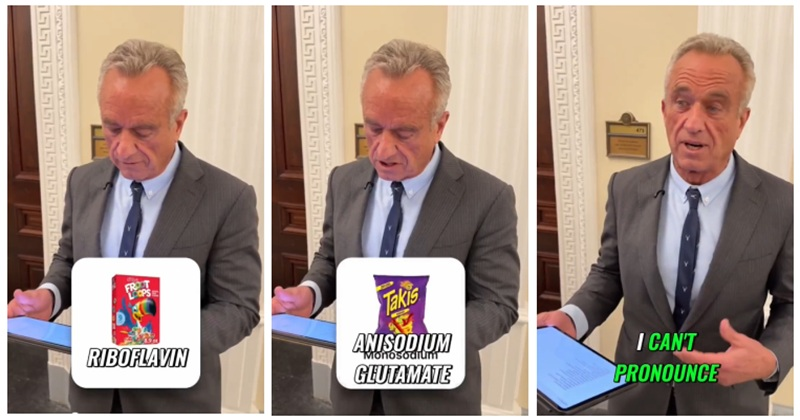
In March 2025, the Secretary of Health and Human Services, Robert F. Kennedy Jr., met with food industry representatives and listed ingredients he wanted out of America’s food. Riboflavin was on the list. He stumbled over the name. (The Poke)
Riboflavin is vitamin B2. It is in milk, eggs and leafy greens. American millers have added it to enriched flour since the 1940s, because a generation of doctors learned what happens to people who go without it.
I don’t raise this because a man mispronounced a word. We all have. I raise it because it is the cleanest example I know of a technique: take something your audience doesn’t understand, say its name in an ominous voice, and let unfamiliarity do the work. No argument required.
Lately my feeds are full of that technique. Memes, many from accounts with no history and no face, pass along talking points built exactly like “riboflavin”: a big word, a scary tone, no evidence. This post is my answer. Not a meme. History and science, with sources, from someone who would rather show his work.
A bright line, four centuries long
The people I admire most in history were not enemies of faith. Most of them prayed. What united them was humility before evidence: the willingness to say “show me,” and to change their minds when shown.
Francis Bacon, 1620. Bacon was a devout Christian. His quarrel was not with prayer but with starting from authority and assuming the answer. In Novum Organum he proposed something radical: observe, test, revise. “Human knowledge and human power meet in one,” he wrote. He also catalogued the “idols of the mind,” the habits that fool us. We’ll come back to one of them.
Galileo, 1633. The Inquisition tried him for reporting what his telescope showed: the Earth moves. He was forced to recant and spent his last years under house arrest. The Church formally acknowledged its error in 1992. Evidence is patient.
Benjamin Franklin, 1750s. For centuries, churches rang their bells during thunderstorms to drive the lightning away. Tall steeples were struck anyway, and bell ringers died at their ropes. Franklin flew a kite, worked out what lightning was, and invented the lightning rod. Within a generation, steeples across Europe and America wore one. Nobody stopped praying. They just stopped dying.
Locke, Voltaire, Jefferson and Madison, 1689 to 1786. Locke’s Letter Concerning Toleration argued that the state has no business compelling belief. Voltaire spent his fame defending people persecuted for their religion. Jefferson and Madison wrote that principle into Virginia law, and Madison carried it into the First Amendment. Pluralism is not a modern fad. It is the founding design. (Robert Ingersoll made the same case a century later; I wrote about him in Every Right You Claim.)
Voltaire even turned the idea into science fiction. In Micromégas (1752), two giants from space visit Earth and question its philosophers. Each one recites his master’s system with total confidence. The giants respect only the follower of Locke, who admits how little he actually knows. Then a theologian announces that the whole universe was made for mankind, and the visitors laugh until they can barely stand. Two hundred seventy years later, it is still the best short lesson I know on the difference between humility and dogma.
Charles Darwin, 1859. Darwin sat on his evidence for twenty years because he knew what it would unsettle, including his own household’s faith. He published anyway, carefully, and invited readers to check his work.
Frederick Douglass, 1854. In Douglass’s day, respected men measured skulls and declared Black people a lesser species. That was the “science” of slavery’s defenders. Douglass took them on directly in an address at Western Reserve College, The Claims of the Negro Ethnologically Considered. He was right, and the evidence has since proven him right.
Dr. Martin Luther King Jr., 1963. King was a Baptist minister and a man of deep faith. He was also the clearest voice I know on where faith and science each belong. “Science investigates; religion interprets,” he wrote in Strength to Love. In the same book he warned that nothing is more dangerous than “sincere ignorance and conscientious stupidity.”
That is the line. Not belief against unbelief. Evidence and open inquiry on one side; dogma and fear on the other. Every person on this list stood on the same side of it.
One human family
Douglass argued from the evidence he had. We now have far more, and it says what he said. When the first draft of the human genome was announced in 2000, the scientists who led the work said plainly that race is not a meaningful biological category.
Any two people on Earth share about 99.9 percent of their DNA. Most human genetic variation sits within any group you might name, not between groups. There is more genetic diversity inside Africa than in the rest of the world combined, because that is where humanity spent most of its history. Trace the family trees of everyone alive back a few thousand years, and they merge. The geneticist Adam Rutherford makes this case beautifully in How to Argue With a Racist and A Brief History of Everyone Who Ever Lived.
None of this erases culture, history, or the very real damage racism has done. Isabel Wilkerson’s Caste shows how a social category can work like a cage without any basis in biology. But the science matters, because prejudice has always tried to borrow a lab coat. Montaigne saw through it in 1580, when he noticed that we call “barbarism” whatever isn’t our own custom (What is Barbarism?). Twain saw through it in 1869 on the road (Travel Is Fatal to Prejudice).
So when a candidate or a meme tells you some group of people is dangerous by nature, you are hearing the skull-measurers again. Humanity as a whole comes first. The evidence agrees.
“Socialism” is the new riboflavin
Remember Bacon’s idols of the mind? One he called the idols of the marketplace: words that mislead because people use them without ever agreeing on what they mean. Four hundred years later, “socialism” is the best example in American politics. It is riboflavin with a flag pin: a word chosen not to explain anything but to frighten people who never stop to ask what it means.
It has a long record. In 1935, opponents called Social Security socialism. In 1961, the American Medical Association distributed a record urging Americans to stop Medicare as “socialized medicine.” Both programs are now so woven into American life that politicians of every party promise to protect them. Adam Hochschild’s American Midnight tells the darker version: during the Red Scare of 1917 to 1921, the fear of radicals became a license for raids, mass arrests and deportations of people who had broken no law.
By the standard of today’s memes, Benjamin Franklin was a dangerous socialist. He organized a lending library, a volunteer fire company, a hospital and a philosophical society, all pooled resources for the common good. He called it being useful.
Socialism, properly defined, means public ownership of the means of production. Almost nothing labeled “socialism” in this year’s memes is that. Funding a cancer lab, a university or a public health system is not seizing the factory. It is an investment, and investments are how private wealth gets built. I made that longer case in You Get to Keep a Portion of the Value You Create.
Mark Twain said the difference between the almost-right word and the right word is the difference between the lightning-bug and the lightning (Lightning and the Lightning-Bug). So here is the test. When someone says “socialism,” ask the riboflavin question: what, exactly, is it? Which policy? What does it cost? What does it produce? If the answer is a scarier tone of voice, you have your answer.
What is at stake on November 3
I’ll be plain about where I stand. This administration has treated expertise itself as the enemy: scientists, doctors, universities and the career public servants who keep the evidence honest. Here is what that looks like.
Science. The National Institutes of Health is the engine of American medicine. Its awards to researchers have fallen off a cliff.
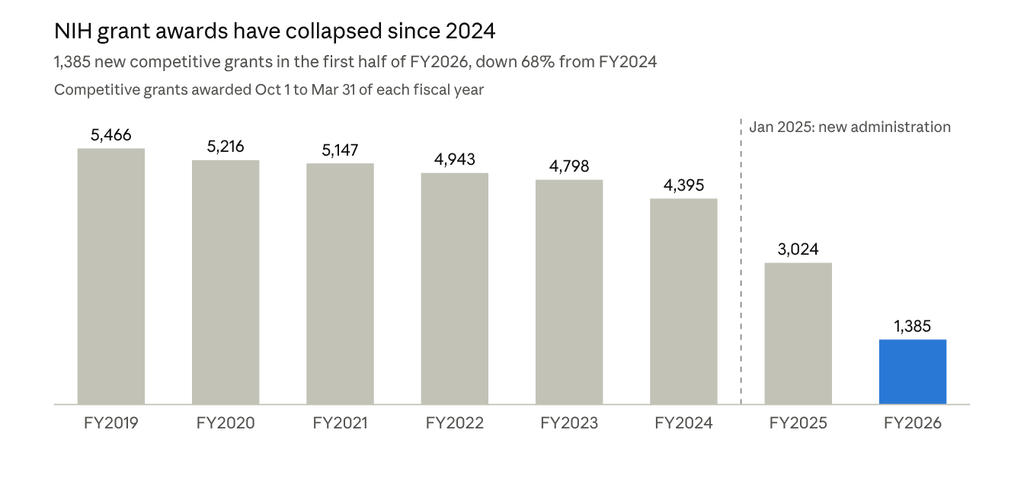
The Washington Post analysis of NIH data, via Becker’s Hospital Review, April 20, 2026
The same analysis found that science agencies lost about 15,000 STEM and health jobs between January 2025 and February 2026. The National Science Foundation lost 42 percent of those workers, against 12 percent across the federal government (Becker’s Hospital Review). Notice one more thing: Congress rejected the administration’s proposed $18 billion cut to NIH for 2026, with votes from both parties. Hold that thought.
Vaccines. Smallpox killed hundreds of millions of people in the twentieth century before vaccination eradicated it in 1980. Measles was declared eliminated from the United States in 2000. Secretary Kennedy fired all 17 members of the CDC’s vaccine advisory committee, which had advised the government since 1964, and appointed replacements, several of whom have questioned established vaccine research. Early in 2026, HHS cut the recommended childhood immunizations from 17 to 11. On March 16, 2026, a federal judge blocked the new schedule and the new appointees, finding the moves likely violated federal law; HHS says it expects to win on appeal (CBS News).
Climate. John Tyndall measured how gases trap heat in 1859. Svante Arrhenius estimated the warming from carbon dioxide in 1896. The evidence has only deepened since. On February 12, 2026, the EPA repealed the 2009 finding that greenhouse gases endanger public health, the legal foundation for most federal climate rules. EPA Administrator Lee Zeldin called it the “single largest deregulatory action in U.S. history” (Jones Day).
Why Congress matters. All 435 House seats and 35 Senate seats are on the ballot (KUTV). The Senate today has 53 Republicans, 45 Democrats and 2 independents (U.S. Senate). The House has 218 Republicans, 214 Democrats, 1 independent and 2 vacancies (Office of the Clerk). Congress writes the budget, holds the hearings and makes the laws that agencies must follow. The NIH vote proved Congress can be a brake. A Congress that trusts evidence can be more than a brake.
The riboflavin test
I am not telling you which names to mark. I am asking you to put five questions to every candidate on your ballot, and to vote for the ones who answer them like Franklin would.
- Will you fund science and listen to scientists, even when the answer is inconvenient?
- Do you accept the evidence on vaccines and on climate?
- Will you defend the courts, a free press, and the rights of people who don’t share your faith?
- Do you treat every human being as equal in dignity, whatever their race or origin?
- When you say “socialism,” what exactly do you mean?
Then vote. Check your state or local election office, or vote.gov, for where and how.
Coming soon: The Numbers Behind the 2026 Election, a series of infographics here on mattfowler.com. More data, so we can all make data-driven decisions.
When the Constitutional Convention closed in 1787, a woman in Philadelphia is said to have asked Franklin what kind of government the delegates had made. “A republic,” he answered, “if you can keep it.” Keeping it has always depended on ordinary people who were willing to ask what things actually are. Riboflavin is vitamin B2. Lightning is electricity. The evidence is the evidence. See you at the polls.
Further reading, from my own shelf
- Steven Pinker, Enlightenment Now: The Case for Reason, Science, Humanism, and Progress (2018)
- Walter Isaacson, Benjamin Franklin: An American Life (2003)
- Adam Rutherford, How to Argue With a Racist (2020) and A Brief History of Everyone Who Ever Lived (2016)
- Isabel Wilkerson, Caste: The Origins of Our Discontents (2020)
- Adam Hochschild, American Midnight: The Great War, a Violent Peace, and Democracy’s Forgotten Crisis (2022)
- Charles Darwin, The Voyage of the Beagle (1839)
- Voltaire, Micromégas (1752), short enough to read in an evening
- Martin Luther King Jr., Strength to Love (1963)
- Francis Bacon, Novum Organum (1620)
Sources
- The Poke, RFK Jr. and riboflavin, March 16, 2025
- Becker’s Hospital Review, summarizing The Washington Post’s NIH analysis, April 20, 2026
- CBS News, judge blocks parts of Kennedy’s vaccine agenda, March 2026
- Jones Day, EPA finalizes repeal of the endangerment finding, February 2026
- KUTV, 435 House seats and 35 Senate races
- U.S. Senate, party division
- Office of the Clerk, U.S. House of Representatives
- Wist, King’s “Science investigates” in Strength to Love
