

The gap at the bottom of the map
This week a map went around Instagram showing the E45, a single highway that runs from the Arctic tip of Norway to the southern coast of Sicily. It is a wonderful line on a map. It also has two gaps in it, and you have to get out of your car and onto a boat for both.
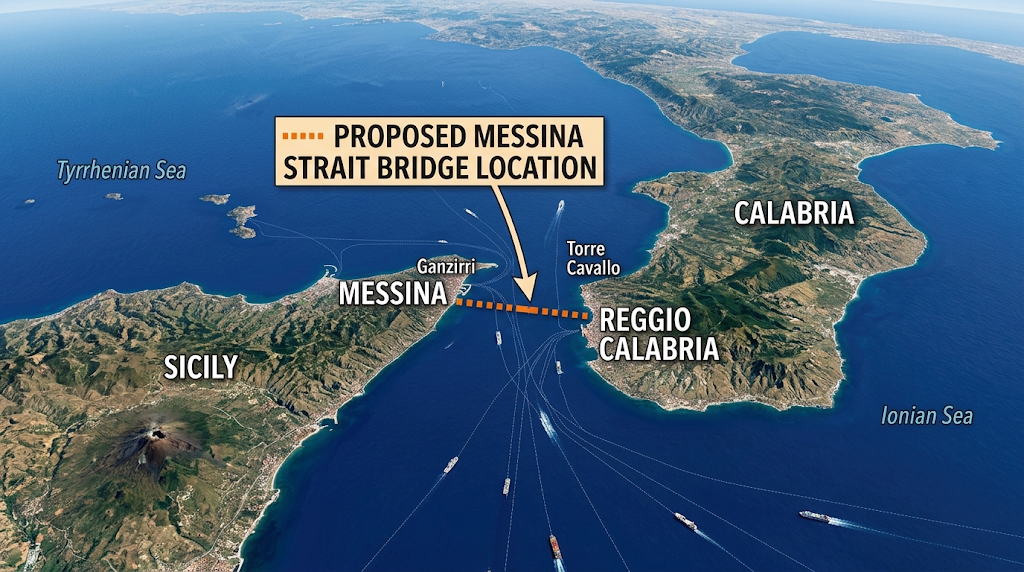
The first gap, between Sweden and Denmark, is a ferry by design. The second, the two miles of water between mainland Italy and Sicily at Messina, is a ferry by default. People have been planning to bridge it for roughly two thousand years. It has never been built.
There is an old line that you miss every shot you don’t take. The Messina bridge suggests a sharper version: failure is assured for every project you don’t start. Planning, studying, approving and announcing are not starting. The strait doesn’t care how good the drawings are.
Boats, barrels and kings
The Romans were the first to take the idea seriously. Pliny the Elder wrote of a plan to cross the strait on a line of boats and barrels lashed together. The plan went nowhere, partly because most traffic through the strait runs north to south, and anything floating across it would block the ships.
The idea kept coming back. Charlemagne considered a chain of bridges. The Norman adventurer Robert Guiscard revived it in the eleventh century, and Roger II of Sicily in the twelfth. Every one of them had the power, the motive and the ambition. None of them started.
A new nation’s first big idea
The engineers arrived in the nineteenth century. A French engineer, Alphonse Oudry, sketched a four-span bridge in 1852. In 1866, just five years after Italian unification, the public works minister Stefano Jacini asked the engineer Alfredo Cottrau to design one. In 1876 the statesman Giuseppe Zanardelli declared the strait could be joined by a bridge or a tunnel.
Then, on December 28, 1908, an earthquake and tsunami flattened Messina and Reggio Calabria. Every plan since has had to answer for that morning. In 1953 the American engineer David Steinman proposed a 5,000-foot span that would have beaten the Golden Gate. It stayed on paper too.
The merry-go-round
The modern era is where the story turns from ambition into habit. Italy held an international design competition in 1968. In the 1980s it created a company, Stretto di Messina, whose whole purpose was to build the bridge. Detailed plans won approval in 1997, and a construction consortium was picked in 2005 for a single 3,300-meter span. That would be more than 60 percent longer than today’s record holder in Turkey.
Then came the cycle. Parliament cancelled the bridge in 2006. Berlusconi revived it in 2009, and crews actually diverted a rail line on the Calabrian shore that December. Monti shut it down again in 2013 for lack of money, and the company went into liquidation. Renzi reconsidered it in 2016, and Conte said in 2020 he would weigh it “without prejudice.”
In 2023 the Meloni government brought the company back to life. In August 2025 it gave final approval to a €13.5 billion plan, and the builders opened a hiring portal. That October, Italy’s Court of Audit refused to sign off. The minister in charge had hoped to break ground in November; he moved it to February, and by spring 2026 he stopped giving dates at all.
As of this week, officials are still preparing paperwork for a fresh vote by the government’s planning committee, followed by another trip back to the same court. The ferry is still running.
Planning is not starting
To be fair to Italy, many of the reasons for stopping were real. Earthquakes, fierce currents, a strained treasury, thin road and rail links on either shore, and the fear that organized crime would feed on the contracts. Not starting a bad project can be wisdom.
But look at what two thousand years of not starting actually bought. The ferry still runs. The studies piled up. A company was founded, dissolved and revived. The risks never went away; they were just rediscovered by each new government. Waiting did not make the decision easier. It made the decision someone else’s problem.
Ben Franklin did not wait for a perfect library or a perfect fire company. He started small ones with his neighbors and let them improve. That is the lesson I take from Messina: every project carries risk once you begin, but the project you never start fails with certainty. If something is worth doing, the most important milestone isn’t the approval. It is the first shovel.
Sources
- Strait of Messina Bridge, Wikipedia
- Italy’s Messina Bridge faces further delays, Global Highways, November 4, 2025
- Ponte Stretto, riunione al Mit con Salvini e Giorgetti, ANSA, October 2, 2026
- Ponte sullo Stretto, nuovo passaggio al Cipess, CanaleSicilia
