
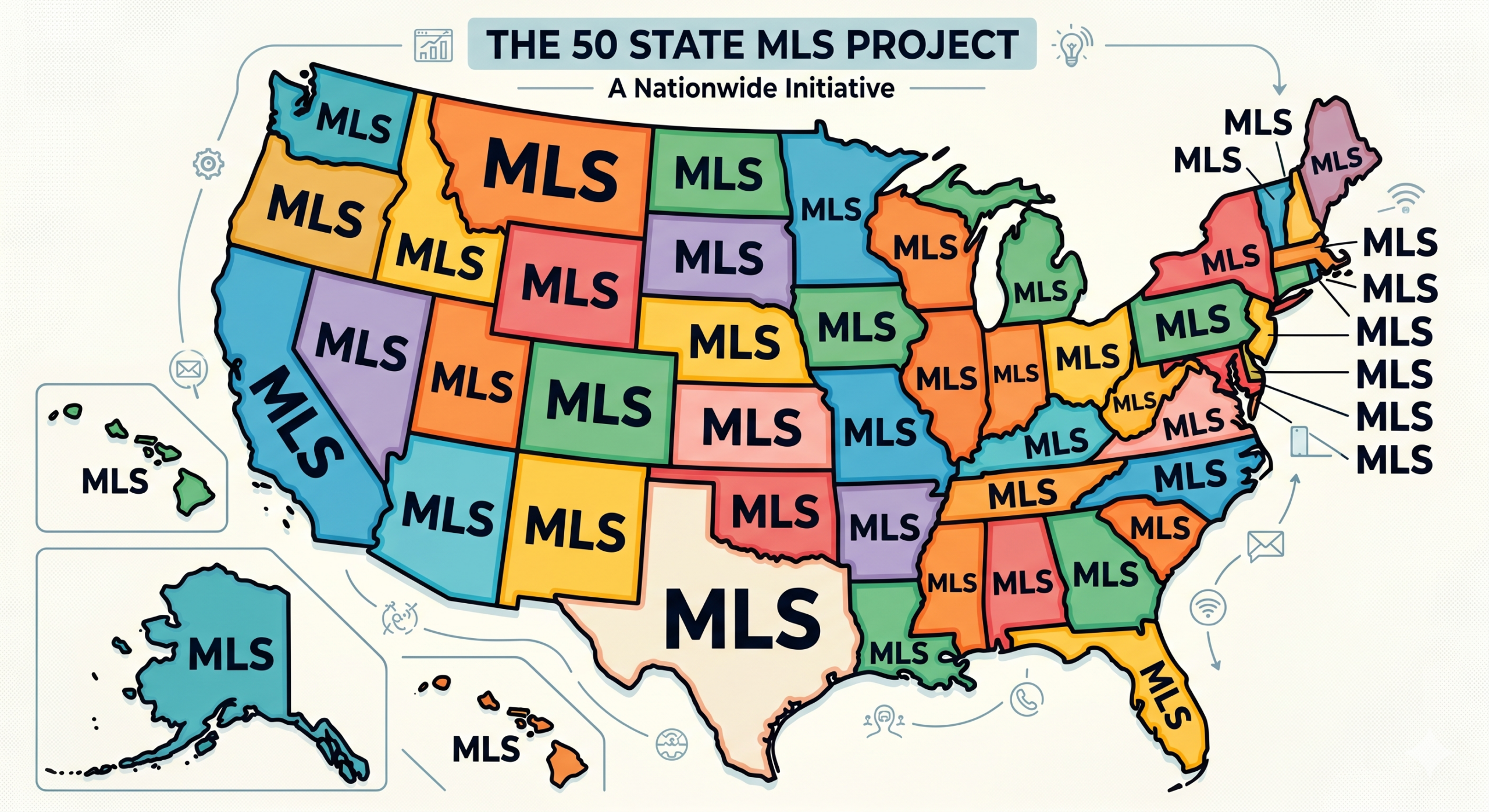
A Thought Experiment About Getting to Fifty Feeds from Five Hundred
By Matt Fowler, CEO of Doorify MLS
Here’s a number that should embarrass us: roughly 500. That’s how many MLS data feeds a national PropTech company has to integrate, normalize, and maintain to serve agents across the United States. Five hundred contracts. Five hundred dialects of the same vocabulary. Five hundred small variations in how a single-family detached home gets described, priced, photographed, and ultimately presented to a consumer.
I lead a regional MLS in the Southeast, so I’m part of that number. And I am genuinely proud of the local decisions we get to make — the rules we write, the policies we enforce, the relationships we keep close. Local control matters. It is, in many ways, the entire point of an MLS.
But local control and national fragmentation are not the same thing. I think we’ve been quietly conflating them for a generation.
So here’s a thought experiment.
Fifty Feeds, Not Five Hundred
Imagine the MLSs in each state — every one of them — agreed to co-develop a single state-level data product. Not a merger. Not a consolidation. Not anyone surrendering their rules, their members, or their identity. A federation.
The product would be a clean superset: every active listing in the state, every licensed real estate professional in the state, and the kind of structured local context — schools, neighborhoods, boundaries — that PropTech companies currently stitch together from a dozen vendors. One feed per state. RESO-compliant. Governed by the contributing MLSs through a federation agreement.
Fifty feeds instead of five hundred. An order-of-magnitude reduction in integration complexity for every PropTech company in the country, without a single MLS losing autonomy.
The local agent would not notice. Her workflow stays in her existing platform, her listings live where they always have, the rules that govern her behavior are still her own MLS’s rules. The federation does not touch her day. What it does touch is the broker building a national tool, the appraiser running comps across state lines, and the multi-market brokerage trying to present a coherent picture of its footprint without inventing data that does not exist, or buying it on the “grey” market.
Federation, Not Consolidation
The word matters.
Consolidation means somebody wins and somebody loses. It means staff get cut, governance gets centralized, and local identity gets absorbed. We have watched enough M&A in this industry to know that consolidation is usually subtraction dressed up as efficiency.
Federation is different. The point of a federation is to do together only what genuinely needs to be done together, and to leave everything else alone. The things that benefit from being done at the state level are precisely the things PropTech has been asking us for: a single clean data product per state, predictable schemas, one contract, one license, one point of integration. The things that benefit from being done locally — rules, policies, broker relationships, dispute resolution, compliance, training, the slow careful work of building trust with subscribers — stay local, where they belong.
What Would It Actually Take?
Three things, and none of them are technological.
A governance model. The contributing MLSs in each state would need a charter — how decisions are made, how revenue is shared, how a member MLS joins or leaves. This is the hard part, and I will not pretend otherwise. But MLSs have been figuring out governance for sixty years. We are not bad at this.
A licensing model. Brokers and PropTech vendors would license the state product on commercial terms set by the federation. Revenue flows back to contributing MLSs through a formula they negotiate together. This becomes a new product line MLSs can offer their brokers — not a replacement for what they already do, but an addition.
A standards foundation. This is where we’ve already done the work. RESO has spent two decades building the schema. The Web API exists. Modern integration patterns like the Model Context Protocol are emerging fast. A state-level federation product does not require inventing technology. It requires using what we already have, together.
The Honest Counterpoints
I’m aware of how this sounds to some of my peers. Another consolidation play dressed up in nicer language. It isn’t, but I understand the suspicion. Trust between MLSs in the same state has not always been our strong suit. Some of us compete for the same brokers. Some of us carry old grievances. Federation asks us to set those down — not forever, just at the federation table.
I am also aware that some MLSs will read this and ask, reasonably, What’s in it for me? The answer is a new product, a new revenue line, and a stronger position in conversations with the national portals and PropTech players who currently treat each of us as a small, inconvenient supplier. Fifty MLS federations speaking with a collective voice would be in a very different negotiating posture than five hundred MLSs picked off one at a time.
And yes, the brokers who work across multiple MLSs in a state would gain immediate value. That is fine. That is the point. We exist to make our subscribers’ work easier, and a great many of them now operate across more than one of us.
Worth a Conversation
This is a thought experiment, not a proposal. I haven’t talked to fifty state-level coalitions. I am not announcing an initiative. I am asking a question: if we could reduce PropTech’s integration burden by an order of magnitude, preserve every MLS’s autonomy, and create a new product MLSs could sell to their brokers — would we be brave enough to try?
The technology is ready. The standards are mostly there. What remains is the harder question of whether the people who run MLSs can imagine working together at a scale we haven’t tried before.
Worth a conversation, I think.
