

Hi all and Happy Summer! Thanks again for being one of Doorify’s growing number of Subscribers. I wrote last month about measuring satisfaction using the Net Promoter Score NPS method. It measures the degree to which our subscribers believe we deliver a “commendable” user experience.
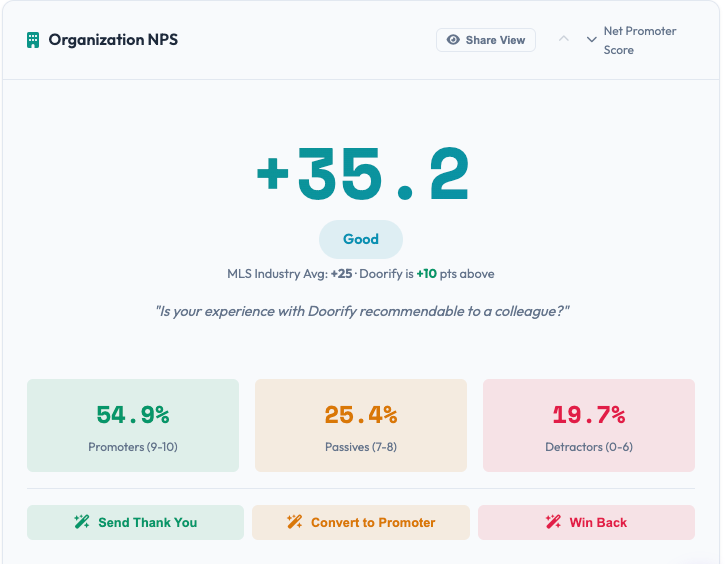
As of today, 54% of 686 responders rated us 9 or 10, NPS calls those Promoters. 25% responded 7 or 8, those are Passives, and 19% were 6 or lower. NPS refers to that last segment as Detractors and those responses are our primary focus.
The survey also invites Subscribers to leave comments, and of course we hear a lot through support@doorifymls.com, the Ardi chatbot, and in person. We listen to every one of them and usually respond directly or open a Support Ticket. Listening helped us identify and fix actual problems for Subscribers and also raise our score.
Please take our brief Satisfaction Survey, it’s always available at: doorifymls.com/survey.
Currently the most common complaint –and consequently the team’s focus– is going to be much harder to solve. Harder because it’s not a technical problem we can just write code to solve. The complaints are, in a way, about complexity itself. Here, let me illustrate what I mean by sharing two recent responses.
June 22nd: Rating 7/10 along with “I hate that I feel like Doorify has become a constant sale of services to me and my business”
June 19nd: Rating 1/10 along with “It used to be so much simpler and less expensive”
These folks are clearly not sold on the new business model, and that’s worth taking seriously. Here’s what I still struggle to convey almost three years later: we knew it was going to be more complex and also more expensive, but the benefits of having a choice of platforms have turned out to be enormous.
Back in 2023, the Board concluded that we were -metaphorically- stuck behind a slow-moving train. Ice Mortgage Technology’s Paragon product wasn’t innovating at the pace of the rest of the industry. Their data infrastructure was not built for integrations, it was not compliant with standards, they were (and are not now) members of Real Estate Standards Organization, and on and on. A change was overdue.
Traditionally, at the end of the MLS contract, the Board of Directors picks a different very Paragon-like product and a cut-over date is set for everyone. On that day, all subscribers are forced off of Paragon losing whatever they had not copied into the Board’s latest choice of MLS platforms. Most markets repeat this every three to five years.. We had gone ten.
Instead — inspired by advances at the Real Estate Standards Organization, and with a new Executive Director (me) who’d spent years working on exactly this problem — the Board chose a different path: choice. We created what is essentially an MLS App Store where subscribers pick from a growing range of products and services. Critically, that included Paragon, eliminating the need to kick everyone off. The project successfully allowed 75% of our 14,000 Subscribers to remain on Paragon while at the same time giving Doorify the new infrastructure we needed to move on. That new infrastructure has since set us up for success with AI and is the envy of the MLS industry.
FBS proved to be the first in the industry to directly support leading AI models like ChatGPT, Claude, and Gemini. If we did not give people a choice to use Flexmls we would be watching our neighbors roll out that technology. Plus there are -entirely optional- technologies on the my.doorifymls.com dashboard that might revolutionize how your brokerage operates and markets that have nothing to do with ICE and Paragon.
The App Store delivers the ability for our organization to be a catalyst for innovation instead of the gatekeeper MLSs have long been. Because of the benefits we are willing to accept that it costs more and increases complexity on the network. Neither of those things are popular, we understand that, so in our defense, I usually draw an analogy to Telecom Deregulation in the 1980s.
Before deregulation phones were cheap and generic but every home had one. That was the reason the government granted a monopoly to the Bell Company, so they could reach that goal: a phone in every home. Once that was accomplished it made sense to remove the monopoly and let the market evolve. So the phone in the hall became that computer in your pocket or purse and costs 10x more. It is also way more than a phone now. When are we going to stop calling it a phone? .
MLS Choice sort of works like this. Paragon had a monopoly for 10 years and delivered a basic service at a low cost. That made sense a decade ago, but technology and data standards advanced to a point where Choice became possible. Almost three years out, both of the new options have better Customer Satisfaction than Paragon and overall Satisfaction is up. We are committed to aggressive cost management to keep rates as low as practical and providing accurate data continues to be our primary objective. Watch for more on both in the Midyear report coming next month and thanks again for being a Subscriber.
