
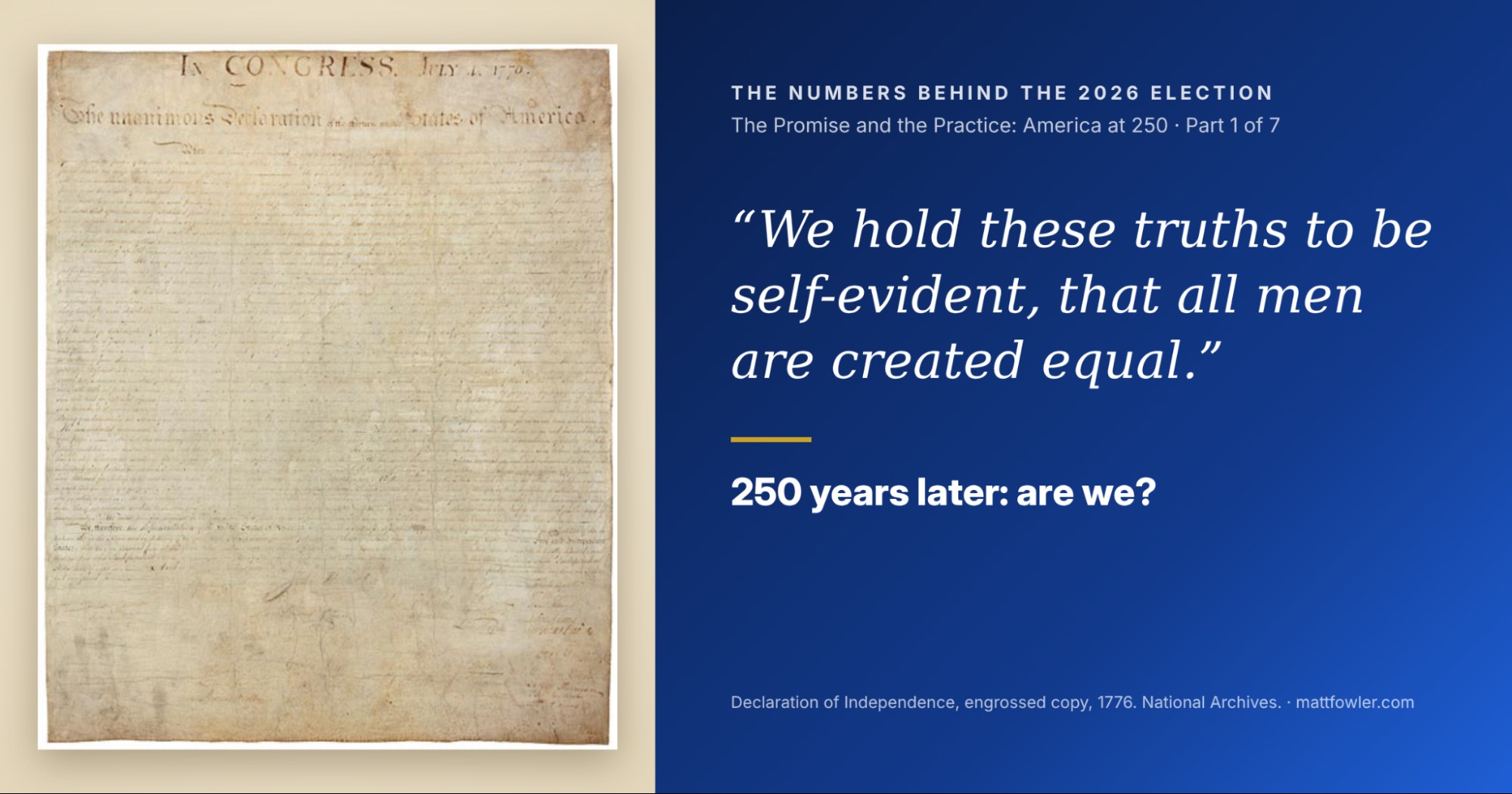
The Numbers Behind the 2026 Election · The Promise and the Practice: America at 250 · Part 1 of 7
Two hundred fifty years ago, a slaveholder wrote the most radical sentence in American history: “We hold these truths to be self-evident, that all men are created equal.” Thomas Jefferson did not live by it. Neither did the country that adopted it. That is exactly what made it powerful.
The sentence was a promise, not a description. And every generation since has had to decide whether to keep it.
A promise people held us to
In 1852, Frederick Douglass stood before an audience in Rochester, New York, and asked what the Fourth of July meant to an enslaved American. “This Fourth of July is yours, not mine,” he told them. “You may rejoice, I must mourn.” He did not reject the Declaration. He demanded the country live up to it.
Eleven years later, at Gettysburg, Abraham Lincoln described a nation “dedicated to the proposition that all men are created equal.” A proposition is something you have to prove.
In 1963, on the steps of the Lincoln Memorial, Dr. Martin Luther King Jr. called the Declaration “a promissory note” and said America had “defaulted” on it for its citizens of color. Then he dreamed out loud that the nation would “rise up and live out the true meaning of its creed.”
What followed was not a dream. It was law. The Civil Rights Act of 1964 and the Voting Rights Act of 1965 gave the promise teeth: lawyers to enforce it, rules to measure it, and districts where Black citizens could finally elect someone they chose.
This series asks one question at America’s 250th birthday: are our institutions moving us closer to our founding promises, or further away? On equality, here is what changed in the last two years.
Four changes, by the numbers
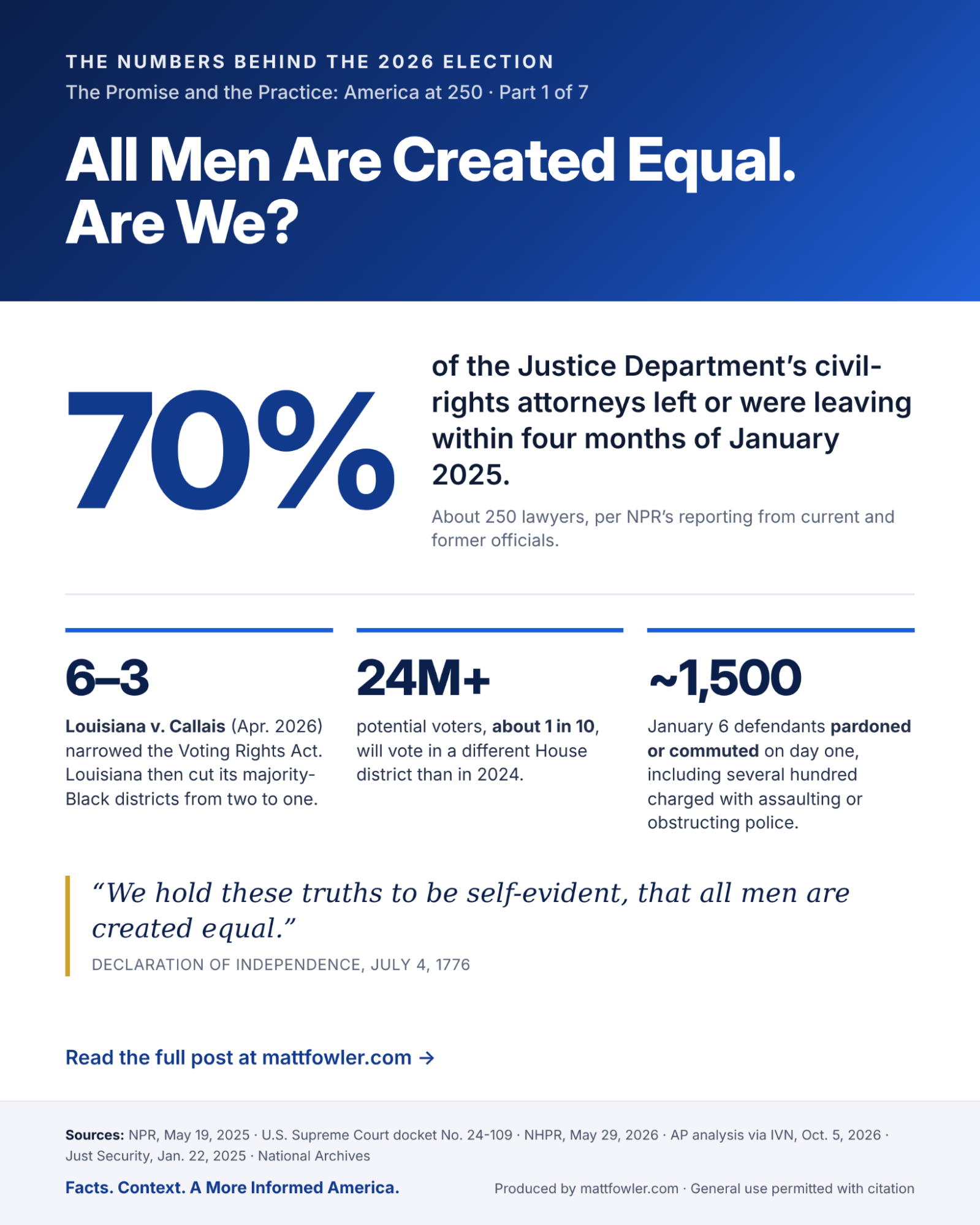
1. The enforcers left. The Justice Department’s Civil Rights Division is the federal office that enforces those 1960s laws. By May 2025, NPR reported, about 70 percent of its attorneys, roughly 250 lawyers, had left or were expected to leave. The figure comes from current and former officials; the department acknowledged departures without confirming a count. In the same months, the department dropped investigations or withdrew court filings in about 30 cases, including voting and hiring-discrimination cases (NPR via LAist).
The division didn’t close. But you cannot lose seven of every ten experienced lawyers and enforce the law the same way.
2. A tool was put away. Title VI of the Civil Rights Act bars discrimination by race, color or national origin in programs that receive federal money. For decades, the Justice Department’s rules under that law let federal officials challenge practices that looked neutral but shut people out without good reason, even when no one could prove anyone meant to discriminate. In December 2025, the department rescinded those provisions (Venable).
To be precise: this did not erase every such protection in federal law. Employment law, for example, still has its own standard. But in federally funded programs, the federal government gave up one of its main ways of catching discrimination that hides inside “neutral” rules.
3. The Voting Rights Act was narrowed. On April 29, 2026, the Supreme Court decided Louisiana v. Callais, 6–3. It held that Louisiana’s second majority-Black congressional district was an unconstitutional racial gerrymander, and it sharply limited when race-conscious districting can be justified. The Court did not strike down the Voting Rights Act. It made its central protection much harder to use (Supreme Court docket, National Constitution Center).
The consequences came within weeks. Louisiana redrew its map in May, going from two majority-Black districts to one. Tennessee split its only majority-Black district, based in Memphis (NHPR).
And it is not only the South. In this unusual mid-decade scramble, nine states will vote Tuesday on changed congressional maps. The AP counts more than 24 million potential voters, about one in ten nationwide, who will vote in a different House district than they did in 2024 (AP via IVN). They didn’t move. Their districts did.
4. Equal before the law, even for critics. “Created equal” means the law weighs us the same, whatever we look like and whatever we believe. On September 20, 2025, the president posted a message to his attorney general naming three of his critics, former FBI Director James Comey, Senator Adam Schiff and New York Attorney General Letitia James: “They’re all guilty as hell, but nothing is going to be done.… JUSTICE MUST BE SERVED, NOW!!!” An administration official said it was meant as a private message (NBC News).
Within weeks, Comey and James were indicted. In November 2025, a federal judge dismissed both cases because the prosecutor who obtained the indictments had been unlawfully appointed. The Justice Department appealed; when the appeals court heard arguments in September 2026, the panel appeared likely to uphold the dismissals (Spokesman-Review/AP). Both deny wrongdoing.
The same law that pursued his critics has forgiven his friends. On his first day back in office, the president pardoned or commuted the sentences of about 1,500 January 6 defendants, including several hundred charged with assaulting or obstructing police officers (Just Security). In November 2025, he pardoned 77 people tied to efforts to overturn the 2020 election, including Rudy Giuliani and Mark Meadows (ABC News). Other pardons went to people with documented financial ties. Nikola founder Trevor Milton, convicted of fraud, had given about $946,000 to Trump causes, $900,000 of it weeks before the 2024 election. Paul Walczak was pardoned weeks after his mother attended a $1 million-a-plate fundraiser promising access to the president. Binance founder Changpeng Zhao was pardoned after his company did business worth $2 billion with the Trump family’s crypto venture, World Liberty Financial, which denies any connection (Forbes).
I can’t see into anyone’s motives, and you shouldn’t take my word on them. But the pattern is public: charges for named opponents, pardons for allies and donors. No one has proven a pardon was bought, and every president has pardoned friends. Still, equal treatment under the law cannot mean one standard for the president’s critics and another for his supporters. I’ll return to this in Part 3, No One Above the Law.
One more gap is worth naming. CBO projects that the 2025 tax-and-spending law will change yearly household resources by about −$1,200 for the lowest-income tenth of households and +$13,600 for the highest tenth (CBO). I’ll come back to what that means in Part 6.
The honest question
There is a serious argument on the other side, and it deserves a fair hearing. It says equality means a colorblind government: the state should never sort citizens by race, not even to repair old wrongs. Practices should be judged by intent, not by outcomes. Much of the Supreme Court now agrees, and many thoughtful Americans do too.
I understand the appeal. A colorblind society is the dream King described, his children judged “by the content of their character.” And to be clear about the law: no group is entitled to a share of seats matching its share of the population. The Voting Rights Act says so in plain words.
But here is the question colorblind law has to answer: does a formally race-neutral system give everyone an equal chance to be heard when some communities have, for generations, had less power to begin with?
History gives us a test case. After Reconstruction, Southern states wrote poll taxes and literacy tests that never mentioned race. They were “neutral” on paper. They disenfranchised Black citizens for most of a century. The laws of the 1960s were built to look past the paper to the results.
My answer is that we are not there yet. A country that is still working toward colorblindness should not throw away the tools that tell it whether it’s succeeding. When the people who enforce equal treatment leave, when the rules for spotting hidden discrimination are rescinded, and when the map changes faster than the voters do, the promise of 1776 gets harder to keep, not easier.
You may weigh it differently. That is your right, and it is what Tuesday is for.
Before you vote
Ask the candidates on your ballot three questions. Will you fund and staff the offices that enforce civil-rights law? Will you protect every citizen’s ability to elect a representative of their choice? And when you say “equal,” do you mean equal on paper or equal in practice?
Douglass, Lincoln and King never asked America to be perfect. They asked it to be honest about the distance between its promise and its practice, and then to close it. That work belongs to us now.
Check your state or local election office, or vote.gov, for where and how to vote on Tuesday, November 3.
Tomorrow, Part 2: Who Belongs in America?
Facts. Context. A More Informed America. Produced by mattfowler.com. General use permitted with citation.
Sources
- NPR via LAist, “70% of the DOJ’s civil rights division lawyers are leaving”, May 19, 2025
- Venable, DOJ final rule limiting Title VI claims, December 2025
- Supreme Court docket, Louisiana v. Callais, No. 24-109
- National Constitution Center, the Callais decision’s new framework
- NHPR, Louisiana passes a map dismantling a majority-Black district, May 29, 2026
- IVN, AP analysis of 24 million voters in changed districts, October 5, 2026
- NBC News, Trump’s post pressuring Bondi to charge his critics, October 10, 2025
- Spokesman-Review, DOJ seeks to revive cases against Comey and James, September 15, 2026
- Just Security, January 6 pardons by the numbers, January 22, 2025
- ABC News, Trump pardons Giuliani and others tied to 2020 election efforts, November 10, 2025
- Forbes, the donors and business allies Trump has pardoned, updated May 2026
- Congressional Budget Office, distributional effects of the 2025 reconciliation act
- National Archives, Declaration of Independence transcript
