
Who Belongs in America?
POST 2 · OCTOBER 31, 2026
During the 2024 campaign, Donald Trump repeatedly promised mass deportations, emphasizing the removal of dangerous criminals. Homeland Security Secretary Kristi Noem subsequently described enforcement as targeting the “worst of the worst.”
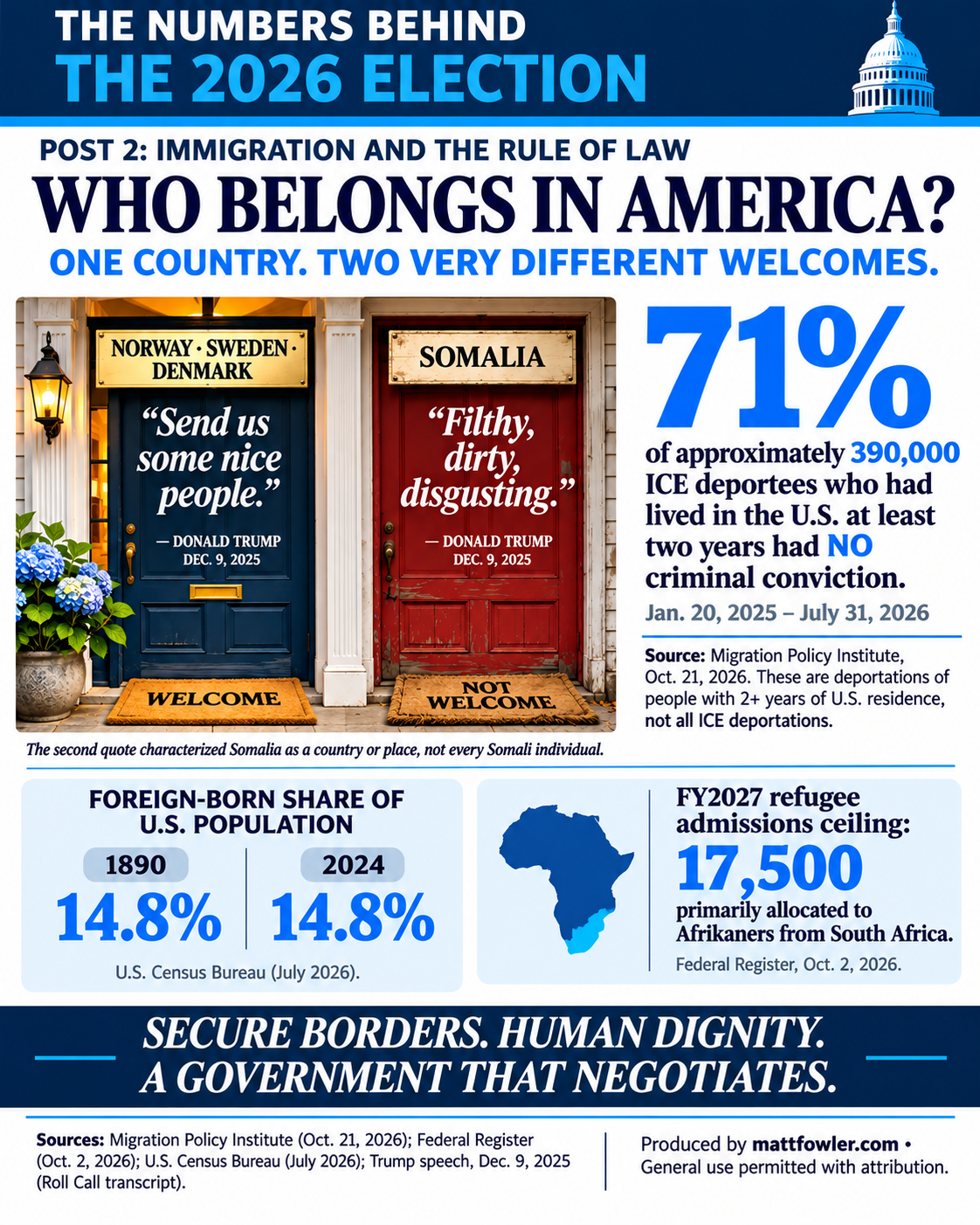
But of approximately 390,000 people deported by ICE after living in America for at least two years, 71% had no criminal conviction. That’s roughly 280,000 people between January 2025 and July 2026.
Having no criminal conviction does not necessarily mean someone has lawful immigration status. But lacking immigration status doesn’t establish that someone is dangerous, either.
And there is another revealing contrast.
In January 2025, Trump suspended the general refugee admissions program. Yet his administration subsequently created special provisions for Afrikaners from South Africa, a predominantly white population. Its refugee admissions plan for fiscal year 2027 prioritizes this group.
The administration cites discrimination against Afrikaners, although independent investigations have not substantiated Trump’s claims of genocide against white South Africans.
In December 2025, the president referred to Somali immigrants as “garbage.” Days later, he publicly expressed a preference for immigrants from Norway, Sweden, and Denmark over people from Somalia.
These are not merely differences in border enforcement. They raise questions about how America determines who is welcome.
How did we arrive here?
For decades, Congresses and presidents of both parties have failed to reconcile border security, demand for immigrant labor, family reunification, and realistic paths to legal residency.
In 2013, bipartisan immigration reform passed the Senate 68–32. It combined stronger enforcement with a conditional pathway to citizenship. The House never voted on it. Another bipartisan border-security proposal failed in 2024.
Meanwhile, millions of immigrants built lives here, working, raising children, paying taxes, and becoming part of American communities.
Here’s some historical perspective: In 1890, 14.8% of America’s population was foreign-born. In 2024, it was 14.8% again. Immigration isn’t some new feature of the American experiment. It has helped define our nation for generations. What has changed is where many immigrants come from—and how we respond to their arrival.
We cannot ignore our collective responsibility for a system Washington has repeatedly failed to repair.
A more orderly system could include accessible work permits, realistic family immigration pathways, effective employment verification, and conditional routes to permanent residency and citizenship.
We also need to distinguish evidence from fear. Noncitizen voting in federal elections is illegal, with documented violations rare. Research using Texas data found lower felony arrest rates among undocumented immigrants than among U.S.-born citizens.
But perhaps the larger question is what kind of government we expect our elected officials to provide.
Compromise is not surrender. Negotiation is not weakness. Respect for the law, the truth, and the dignity of others is not optional in a functioning democracy.
America is an extraordinarily diverse country. We will never agree about everything. That is precisely why our institutions, political traditions, and willingness to work across differences matter so much.
We should expect leaders to govern, not merely to win arguments. To solve problems rather than perpetuate them. To recognize that political opponents are fellow Americans, not enemies.
Jefferson wrote that all men are created equal when the nation was nowhere near honoring that principle. Emma Lazarus imagined a golden door that America has never kept equally open.
Our American mythology is powerful not because it accurately describes everything we have been, but because it challenges us to become something better.
As we approach November 3, I hope Americans will consider more than which candidates share their grievances. Consider which individuals and parties demonstrate the values we claim to cherish: liberty, equality, honesty, justice, compassion, individual responsibility, and respect for the rule of law.
Vote according to your conscience, for those you believe will uphold those principles—even when doing so requires compromise, courage, or standing against their own political allies.
America has never perfectly fulfilled its founding promises.
But those promises remain ours to keep.
Sources: Migration Policy Institute, October 2026 · FactCheck.org, ICE Arrests · 2027 Refugee Determination · FactCheck.org, South Africa · Reuters, Somalia Remarks · Trump’s December 2025 Speech · Senate Immigration Reform Vote · PNAS Crime Study · U.S. Census Bureau, Immigration History
Produced by mattfowler.com · General use permitted with attribution.
